Every March, millions of fans pack into arenas across the country to watch college basketball’s biggest stage. The roar of the crowd, the instant replay on a massive jumbotron, the Wi-Fi signal you’re using to text your bracket picks to your group chat — it all feels seamless. But underneath the hardwood, behind the walls, and above the drop ceilings, there’s an enormous amount of low-voltage infrastructure quietly making every moment possible.
Most people never think about it. That’s exactly how it’s supposed to work.
But pull back the curtain on any major arena — a Madison Square Garden, a Dean Smith Center, a Gainbridge Fieldhouse — and what you find isn’t magic. It’s miles of fiber optic and copper cabling, hundreds of wireless access points, meticulously organized data closets, and an integrated systems design that took months of planning to pull off. It’s the kind of infrastructure that, when it works, is completely invisible. And when it doesn’t, 20,000 people notice immediately.
The Fiber Backbone: Moving Mountains of Data in Milliseconds
Start with the foundation. Every modern arena is built on a fiber optic backbone — a high-capacity network of fiber cabling that serves as the central highway for all data moving through the building. Video feeds, scoreboard signals, broadcast data, security camera footage, network traffic — it all travels across this backbone.
Fiber is the only practical choice at this scale. It can carry vastly more data than copper over much longer distances without signal degradation, and it does it fast enough that a camera capturing a slam dunk and the jumbotron displaying it are essentially in sync. In a building where thousands of feet of cable might separate a camera from a display, that matters enormously.
The fiber backbone also connects what are called intermediate distribution frames (IDFs) — essentially satellite network closets distributed throughout the arena — back to the main distribution frame (MDF), which is the central hub where everything terminates. A large arena might have a dozen or more IDFs spread across different levels and zones, each serving the systems in their section of the building, all tied together through the backbone.
Planning a fiber backbone for a facility like this isn’t just about capacity today. It’s about headroom for the future — higher resolution displays, more connected devices, new broadcast technologies. The cabling infrastructure that gets installed is meant to last 15 to 20 years and support technologies that haven’t been invented yet.
20,000 Fans, All on Wi-Fi at the Same Time
Here’s the challenge that keeps network engineers up at night: everyone in a packed arena pulls out their phone at the exact same moment. A buzzer-beater happens. The crowd erupts. And instantly, 18,000 people are trying to post a video, stream a replay, check their bracket, or call the friend watching at home. All at once.
Consumer Wi-Fi networks fail under this kind of demand because they’re designed for much lower device density. Arena-grade wireless infrastructure is a different animal entirely.
Modern arenas use what’s called high-density wireless deployment, which means instead of a handful of powerful access points mounted high on the ceiling, there are hundreds of lower-power access points mounted close to the people using them — often underneath seats, in seatback mounts, or along the underside of upper deck overhangs. The logic is counterintuitive at first: more, weaker access points outperform fewer, stronger ones in dense environments because they reduce interference and keep each AP serving a manageable number of devices.
A facility like Allegiant Stadium in Las Vegas reportedly has over 1,800 wireless access points. State Farm Arena in Atlanta completed a full wireless infrastructure overhaul specifically to support the density of playoff crowds.
Every single one of those access points is hardwired back to the network through structured cabling. The wireless experience fans have on their phones only exists because of the wired infrastructure running behind the walls and under the seats to support it. There is no high-density Wi-Fi without high-density cabling.
Arenas also layer in a Distributed Antenna System (DAS) to boost cellular coverage from carriers like Verizon, AT&T, and T-Mobile inside the building. Stadium concrete and steel are notorious for blocking cell signals, so a DAS essentially creates an internal cellular network — antennas placed throughout the building, all connected back through coaxial and fiber cabling to a central system that interfaces with the carriers. Fans don’t know it exists. They just notice that their phone actually works inside the arena.
The Scoreboard, the Shot Clock, and the Replay System
That massive LED display hanging over center court weighs several tons and contains hundreds of thousands of individual pixels. It’s fed by a video distribution system that’s receiving signals from multiple sources simultaneously — broadcast cameras, graphics computers, in-arena production systems — and switching between them in real time.
The video infrastructure behind a major scoreboard involves fiber runs carrying uncompressed or minimally compressed video, dedicated network segments to keep scoreboard traffic isolated from general arena traffic, and redundant pathways so that a single cable failure doesn’t blank the screen during a national broadcast.
The shot clock is its own system — synchronized across multiple displays around the court and at the scorer’s table, with sub-second precision required by NCAA and NBA rules. It runs on its own dedicated cabling that ties the timing system, the scorer’s table, and the displays into a single synchronized network.
Replay systems are arguably the most data-intensive thing happening in an arena on game night. High-frame-rate cameras capturing footage that can be slowed down to show whether a foot was on the line requires enormous bandwidth and fast storage. The fiber infrastructure that makes instant replay possible is moving data at speeds that would have seemed impossible twenty years ago.
The Sound System: Covering 20,000 Seats Without an Echo
Getting clean, intelligible audio across a massive arena is one of the hardest problems in AV system design. The physics work against you. Hard surfaces — concrete, glass, steel — reflect sound in every direction. The distance between the nearest speaker and the farthest seat can be enormous. And the ambient noise of a live crowd is relentless.
Modern arena sound systems solve this through a combination of speaker placement, digital signal processing (DSP), and — critically — the cabling infrastructure that ties it all together.
Rather than a handful of large speaker clusters, today’s arena sound systems use distributed speaker arrays — dozens or hundreds of speakers positioned strategically throughout the seating bowl, concourses, suites, locker rooms, and back-of-house areas. Each speaker zone is independently controllable, so the system can route a PA announcement to the concourse without blasting it over the game audio in the seating bowl.
All of those speaker zones are connected through low-voltage audio cabling running back to a central DSP and amplifier rack. The signal path from the announcer’s microphone to the speaker above your seat might travel through hundreds of feet of cabling and several processing stages in milliseconds. The cabling design determines whether that audio arrives clean or arrives degraded.
Access Control: 30 Entry Points and Hundreds of Restricted Doors
On a sold-out game night, a major arena is also one of the most logistically complex security environments you’ll encounter outside of an airport or a government facility. There might be 30 or more public entry points, dozens of restricted access doors for players, staff, media, and officials, loading docks, VIP entrances, and a security operations center monitoring all of it in real time.
Every access control reader — the card readers and credential scanners at restricted doors — is a networked device that has to communicate with a central access control system. Every IP surveillance camera is streaming continuous video back to storage and to the SOC. Every door contact, every motion sensor, every alarm point is generating data that the security system is processing constantly.
This is where Power over Ethernet (PoE) becomes essential. PoE technology allows a single network cable to carry both data and electrical power to a device, eliminating the need to run separate power lines to every camera and access reader. In a large arena, the cost and complexity savings from PoE are substantial — instead of coordinating with electricians to run power to hundreds of camera locations, the low-voltage cabling contractor handles it all with a single cable pull.
The surveillance infrastructure in a modern arena is also designed with redundancy in mind. Critical camera feeds have redundant fiber paths. Recording systems have failover storage. The cabling infrastructure is designed so that no single point of failure can take down visibility in a critical zone.
Emergency Systems: The Infrastructure Nobody Wants to Need
Behind all the entertainment infrastructure is a layer of systems that exist for one purpose: keeping people safe when something goes wrong.
Mass notification systems in modern arenas can deliver targeted audio and visual alerts to specific zones — directing fans in section 200 to a particular exit while keeping the rest of the arena calm, for example. These systems run on dedicated, supervised cabling that is tested regularly and required to meet life-safety codes.
Emergency responder radio coverage is another requirement in large public assembly facilities. First responders need their radios to work inside a concrete-and-steel building that would otherwise block their signals completely. A bi-directional amplifier (BDA) system — essentially the public safety equivalent of the fan DAS — is required by code in most jurisdictions for buildings of this size. It runs on its own cabling infrastructure and is tested and certified regularly.
Fire alarm systems, emergency lighting, and exit sign power all fall under the low-voltage umbrella as well, with strict code requirements around the cabling, conduit, and installation methods used.
What This Means for Your Building
You don’t manage a 20,000-seat arena. But if you manage a commercial office building, a school campus, a hospital, or a government facility, you are running many of the same categories of systems at a different scale — wireless networks, AV in conference and training rooms, integrated security, overhead paging, access control, emergency communications.
The infrastructure principles are exactly the same. A school that wants to deploy cameras, card readers, and a mass notification system faces the same fundamental design questions as an arena: How do all these systems share a common cabling infrastructure? How do we build in redundancy? How do we design for where we’re going, not just where we are today?
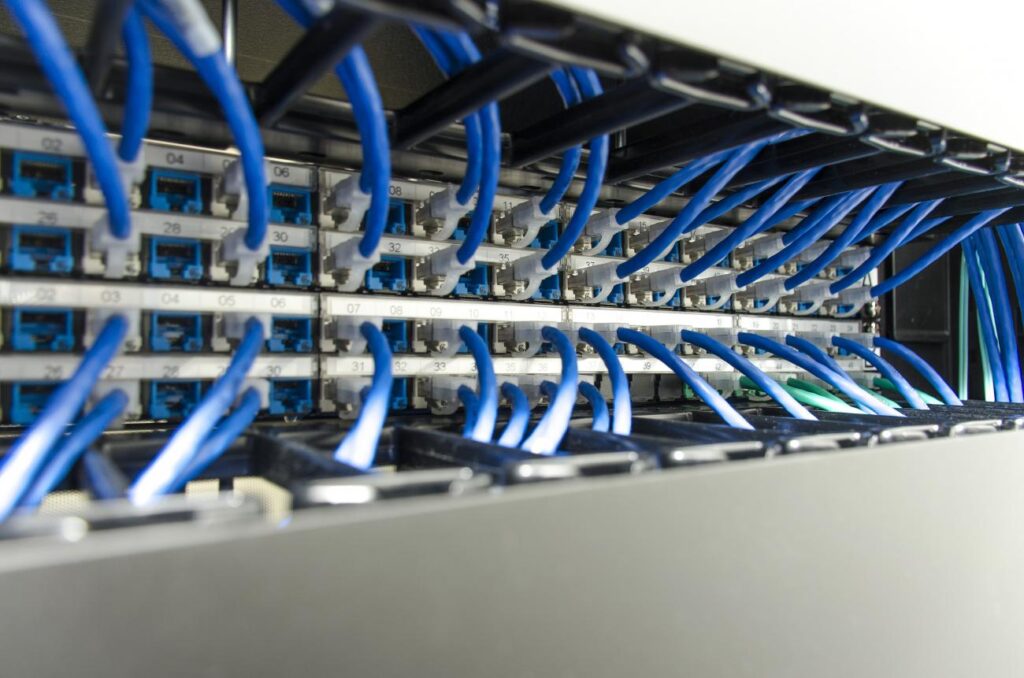
The difference between a facility that runs flawlessly and one where the Wi-Fi is unreliable, the AV constantly needs attention, and security can’t pull up a camera feed when they need it is almost always traceable to the quality of the cabling infrastructure underneath. Structured cabling isn’t glamorous. It’s not what anyone takes photos of. But it is the reason every other system in the building either works or doesn’t.
The arena gets this right because it has to — 20,000 fans and a national TV broadcast have zero tolerance for failure. The question worth asking is whether your facility’s infrastructure is being held to the same standard.
Systcom Builds the Infrastructure Behind the Moment
At Systcom, we’ve spent over 30 years designing and installing the low-voltage infrastructure that keeps commercial, educational, healthcare, and government facilities running at their best. Network cabling, fiber optic systems, AV, integrated security, wireless, paging — we design these systems to work together, built right the first time.
If your building’s infrastructure is due for a review — or if you’re planning a new build, a renovation, or an expansion — we’d love to talk through what the right foundation looks like for your facility.
Frequently Asked Questions
How many miles of cabling does a major arena actually have?
A large modern arena can contain anywhere from 500 to over 1,000 miles of cabling when you account for every network cable, fiber run, audio cable, security camera wire, and low-voltage system in the building. It’s one of those numbers that sounds impossible until you start counting the systems — thousands of individual cable runs, each terminated at both ends, all organized back to centralized distribution points throughout the facility.
How do arenas handle Wi-Fi for tens of thousands of people at once?
The secret is density, not power. Rather than a few high-powered access points mounted on the ceiling, arenas install hundreds of lower-power access points mounted underneath seats, on railings, and along the undersides of upper decks — as close to people’s devices as possible. Each access point is hardwired back to the network through structured cabling. The wireless experience only works because of the wired infrastructure supporting it.
What keeps a scoreboard or jumbotron running without any lag?
Fiber optic cabling. Unlike copper, fiber can carry massive amounts of video data over long distances without any signal degradation or latency. A major jumbotron is receiving live camera feeds, graphics, and replays simultaneously from a production system that could be hundreds of feet away. Fiber moves that data fast enough that what you see on screen is essentially real time.
Why don’t cell phones lose signal inside a packed concrete arena?
Because of a system called a Distributed Antenna System, or DAS. Thick concrete and steel construction blocks outdoor cellular signals almost completely. A DAS solves this by installing a network of internal antennas throughout the building — connected through coaxial and fiber cabling — that rebroadcast carrier signals from inside. Fans don’t know it exists. They just notice their phone actually works.
How is the PA system able to reach every corner of a massive arena clearly?
Modern arena sound systems use distributed speaker arrays rather than a few large clusters. Dozens or hundreds of speakers are positioned throughout the seating bowl, concourses, suites, and back-of-house areas, each connected through low-voltage audio cabling back to a central processing system. The DSP — digital signal processor — controls the timing and volume of each zone independently, which is how an announcement can play clearly over the concourse without interrupting the game audio in the seating bowl.
How do arenas manage security across dozens of entry points simultaneously?
Through an integrated security infrastructure built on networked cabling. Every access control reader, every IP surveillance camera, and every alarm point communicates back to a central security operations center through the same structured cabling backbone that supports the rest of the building. Power over Ethernet (PoE) cabling is used extensively — carrying both data and power to cameras and readers over a single cable — which makes large-scale deployments practical and keeps installation costs manageable.
What happens to arena infrastructure during an emergency?
Life-safety systems in arenas run on dedicated, supervised cabling that is completely separate from general network infrastructure. Mass notification systems can deliver targeted alerts to specific zones of the building. Emergency responder radio systems — required by code in most large public assembly facilities — ensure first responders can communicate inside a building that would otherwise block their signals. These systems are tested and certified regularly and are designed with redundancy so a single cable failure cannot take them offline.
My building isn’t an arena — why does any of this apply to me?
Because the categories of systems are identical, just at a different scale. An office building, school, hospital, or government facility runs the same types of infrastructure — wireless networks, AV, integrated security, access control, paging, emergency communications. The principles that make an arena work flawlessly under extreme pressure are the same principles that determine whether your facility’s systems are reliable or frustrating on an ordinary Tuesday. The arena just makes the stakes — and the consequences of getting it wrong — impossible to ignore.